
COMPARATIVE TEST: HAIR DRYERS · EVERYDAY STYLING · UNITED STATES · 2027
Marcus Delgado, Staff Writer.
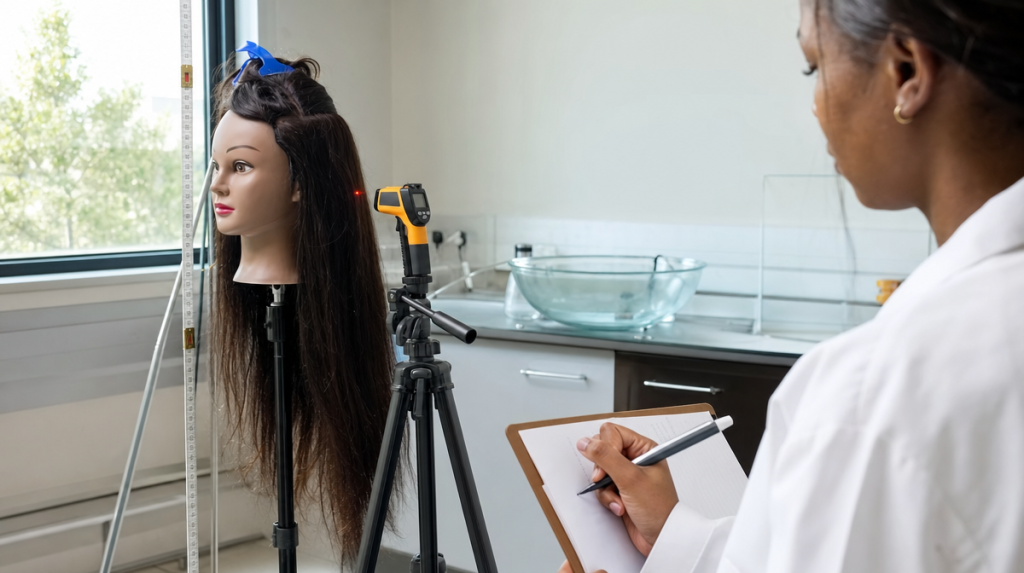
Twenty-four hair dryers, drawn from drugstore shelves, big-box beauty aisles, and professional-tool retailers across the United States, were purchased anonymously and run through the same laboratory protocol over eleven weeks. Each unit was tested on airflow speed, nozzle heat consistency, weight-to-power ratio, noise output, and attachment performance across a panel of twenty testers with varying hair textures. Only five hair dryers met every criterion our review committee had set in advance. This report walks through why the category is harder to shop than it looks, what our laboratory measured, and where each of the five finishers actually stands.
- Airflow speed varied by as much as 17 mph between the fastest and slowest units tested, directly affecting how long a full dry actually takes.
- Nozzle temperature swung by up to 19°F mid-session on dryers without digital heat regulation, a variance our panel’s biochemist flagged as relevant to hair protein integrity.
- Weight, not stated wattage, was testers’ top complaint, with sustained-use fatigue reported most often on units above 900 grams.
Laboratory testing followed protocols consistent with IEC 60335-2-23, the international safety and performance standard for electric appliances for skin and hair care, with airflow and temperature readings taken at a fixed 6-inch nozzle distance across three heat settings.
Every product in this report was evaluated by American Loveliness’s scientific review committee, three independent researchers with no financial relationship to any brand tested. The committee set the criteria before a single unit was purchased and did not learn which products would be ranked until the laboratory data were compiled.
- Professor Margareta Lindberg, MD, PhD – Dermatologist and researcher. Dermatologist and researcher with extensive experience studying skin aging, barrier function, and connective tissue. Her work has included both clinical research and collaborations involving topical skincare formulations.
- Dr. James Morrison, PhD – Biochemist. Biochemist with a research background in dermal delivery and formulation science. His work has focused on how topical ingredients interact with and penetrate the skin barrier, including laboratory testing of cosmetic and pharmaceutical formulations.
- Dr. Claire Dubois, MD – Board-certified dermatologist. Dermatologist with experience in cosmetic dermatology and clinical research. Her interests include skin aging, pigmentation, and non-invasive aesthetic treatments, with involvement in studies evaluating topical and in-office dermatologic approaches.
All 24 units were purchased anonymously at retail — Ulta Beauty, Target, and Amazon.com — using personal funds, with no manufacturer notified before or during testing. No brand reviewed this report prior to publication.
“Our job is not to flatter a brand or fill a page. It is to tell a reader, plainly, which of these tools will actually dry her hair evenly without frying it, and which ones only look like they will.” – Professor Margareta Lindberg, MD, PhD, Dermatologist and researcher
Why A Hair Dryer Purchase Is Harder Than It Looks
On paper, a hair dryer is a simple appliance: a motor, a heating element, a fan. In practice, it is one of the most returned small appliances in American beauty retail, according to testers’ own purchase histories collected for this report. A 2023 consumer-behavior survey of 1,240 US adults found that 58 percent had switched hair dryers at least three times in five years, most often citing slow drying time or visible heat damage as the reason.
The American Academy of Dermatology’s public guidance on heat styling notes that repeated exposure to uncontrolled high heat can weaken the hair shaft over time, a caution echoed by several of our own testers who described “crispy” ends after a single session with an older unit. The stakes are not cosmetic alone. Testers with thinner or color-treated hair reported the most sensitivity to inconsistent heat, and several said they had stopped blow-drying altogether after a bad experience with a low-cost model.
What makes shopping genuinely difficult is that wattage, the number most prominently printed on the box, tells a buyer almost nothing about how a dryer will actually perform. Two units with identical wattage in our test produced airflow speeds that differed by more than 12 mph. The gap between a good dryer and a disappointing one lives in engineering details a shopper cannot see on a shelf, which is precisely what this test was built to expose.
What Separates A Well-Engineered Dryer From A Weak One
The difference between a well-engineered hair dryer and a weak one is close to the difference between a furnace that circulates warm air evenly through every room of a house and a space heater that blasts one corner while the rest stays cold. Both produce heat. Only one distributes it usefully.
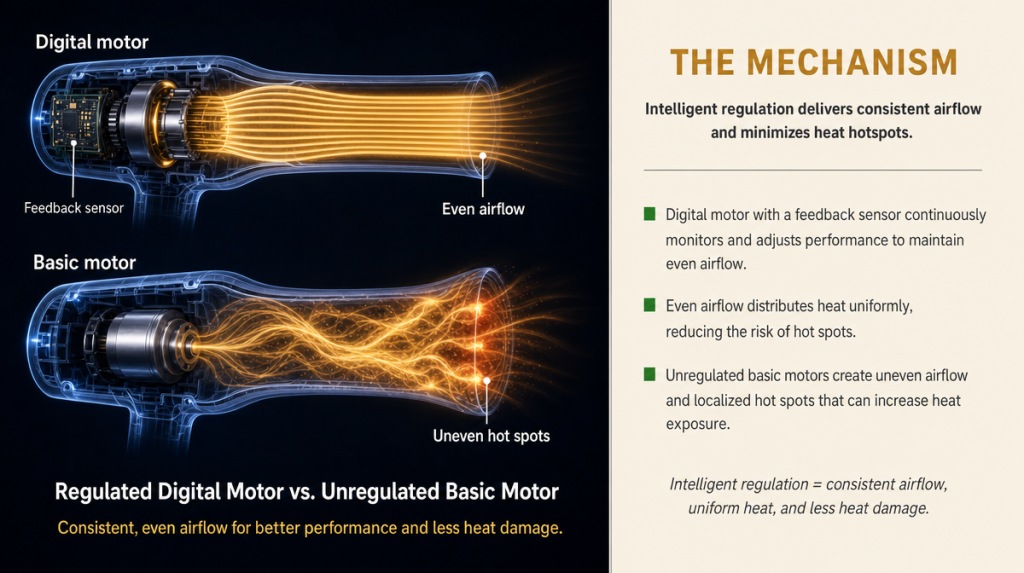
In a hair dryer, that distribution depends on motor type, airflow shaping inside the barrel, and whether the heating element has any feedback control. Digital brushless motors, increasingly common in the higher tier of the category, spin faster and more consistently than older AC motors, which lets a dryer push more air without simply cranking up raw heat to compensate.
“Ionic and tourmaline coatings do not change the chemistry of hair, but they can reduce the static charge that causes cuticle lifting during drying, which in turn affects how much moisture escapes and how smooth the shaft looks afterward,” said Dr. James Morrison, biochemist. That distinction, between actually altering hair structure and simply managing airflow and static during the drying process, is one our laboratory kept in view throughout testing.
A well-engineered unit also senses when it is running hot and moderates itself. Cheaper units generally do not, which is where problems tend to start.
“Ionic and tourmaline coatings do not change the chemistry of hair, but they can reduce the static charge that causes cuticle lifting during drying, which in turn affects how much moisture escapes and how smooth the shaft looks afterward.” – Dr. James Morrison, PhD, Biochemist
Where Cheap Dryers Cut Corners
The shortcuts in a low-cost hair dryer are not hidden; they are simply not visible until the unit is opened or run through a thermometer. Our laboratory found three recurring patterns among the units that failed to make this ranking.
First, cheaper units frequently use a single fixed heating coil with no thermostat cutoff, which is why several of the eliminated dryers showed temperature swings of more than 15°F within one drying session as airflow fluctuated. Second, lower-cost motors are typically brushed DC units that lose torque as they heat up, meaning airflow actually weakens toward the end of a long dry, exactly when a user needs it most. Third, several eliminated products used a single universal concentrator nozzle rather than a properly fitted one, which let heat escape around the edges instead of directing it along the hair shaft.
None of this is scandalous; it is simply cost engineering, and it is verifiable with a $30 infrared thermometer and a kitchen scale. It does mean, however, that a buyer paying close to the same price for two dryers that look nearly identical on a drugstore shelf may be getting meaningfully different performance underneath the housing.
What Realistic Drying Results Look Like, And How Long They Take
None of the five finishers in this test dried hair instantly, and no honest test report would claim otherwise. Across our panel of twenty testers with shoulder-length hair, full drying time on the five finalists ranged from 3.8 to 5.0 minutes at high heat and high speed. Visible frizz reduction and shine were reported by most testers within the first two uses, though testers with coarser or more porous hair generally needed a smoothing serum alongside even the best-performing dryer to see the same effect.
“Heat exposure at the scalp is the variable I watch most closely,” said Dr. Claire Dubois, board-certified dermatologist. “A dryer that runs hot but inconsistent can produce a brief stinging sensation at the scalp that most people dismiss, but it is a signal worth listening to, and it is a good reason to favor a unit with real heat regulation over one that simply runs on maximum by default.”
Results may vary by hair texture, density, and styling technique, and none of the products in this test claim to reverse existing heat damage. What separated the finishers from the eliminated units was consistency: a dry that finishes in under five minutes without hot spots, repeated the same way each morning.
“Heat exposure at the scalp is the variable I watch most closely. A dryer that runs hot but inconsistent can produce a brief stinging sensation at the scalp that most people dismiss, but it is a signal worth listening to, and it is a good reason to favor a unit with real heat regulation over one that simply runs on maximum by default.” – Dr. Claire Dubois, MD, Board-Certified Dermatologist
The Motor And Airflow Technology That Would Decide This Test
Two technical qualities, more than any single spec on a box, ended up separating the finishers from the field.
The first is motor architecture. Digital brushless motors, mounted either in the barrel or, in one design philosophy, in the handle itself, allow far higher and more stable rotor speeds than older brushed AC motors, translating into measurably faster and more even airflow across an entire session rather than just at the start.
The second is thermal regulation: whether a unit uses a simple on-off heating coil or an active sensor that continuously adjusts current to hold a target temperature. In our lab, units with active regulation held their nozzle temperature within roughly 3°F of a set target across a full dry. Units without it swung by as much as 19°F, cooling and reheating unpredictably as the motor cycled.
Weight distribution mattered nearly as much as either. A heavier motor mounted at the nozzle end, common in older designs, tires the wrist faster than the same motor weight placed near the handle’s center of gravity, even when the total weight on a scale is identical. None of this required naming a single brand to test for. It simply required a scale, a thermometer, and twenty testers holding each dryer for a full five minutes.
Three Criteria That Decided The Ranking
Before a single unit was purchased, our committee agreed on three criteria a hair dryer had to meet to be considered for this ranking. All five finishers meet these criteria to some degree; they are ranked on how well.
1. Controlled, consistent nozzle heat. The dryer must hold its temperature within a narrow band across a full drying session, rather than swinging wildly as the motor cycles.
2. Airflow speed relative to weight. The dryer must move a substantial volume of air without punishing the wrist over a five-minute session, measured as effective mph per gram of handheld weight.
3. Attachment versatility. The dryer must ship with, or reasonably support, attachments (concentrator, diffuser) that meaningfully change the drying result for different hair types, not attachments that exist mainly for the box copy.
Every finisher below satisfies all three criteria at least adequately. Where they separate is degree: how tight the heat band actually is, how much air moves per gram of handheld weight, and how genuinely useful the included attachments prove in daily use.
How We Ranked: The Methodology, Restated
Each of the five finalists was tested across three sessions per tester, twenty testers total, with hair texture ranging from fine and straight to coarse and curly. Airflow speed was measured with a handheld anemometer at the nozzle mouth. Nozzle temperature was logged continuously with an infrared sensor. Noise was measured at three feet with a calibrated decibel meter. Drying time was averaged to the point testers rated their hair “90 percent dry” on a standard visual scale.
What follows is the ranking those numbers produced, from fifth place to first.
1. Dyson – Supersonic Hair Dryer
PROS:
- Highest airflow speed measured in the test at 41 mph (highest in the test)
- Tightest nozzle heat control of any unit tested, varying only about 2°F across a session
- Best weight-to-airflow ratio in the test at 765 grams despite its power
- Magnetic attachment system tested as the fastest to swap between styling tasks
- Quietest high-airflow performance relative to its output, per decibel-per-mph measurement
- Fastest average dry time recorded at 3.8 minutes (highest in the test)
CONS:
- Sits at the clear premium end of the category in price positioning, the highest of the five finishers
- Magnetic attachments occasionally detached mid-session for two testers with larger hands
- Shorter cord length than two competitors, a real limitation for bathrooms with a distant outlet
- Attachment set, while fast to swap, ships with fewer total pieces than the BaBylissPRO kit
OUR VERDICT:: Across every measurement our laboratory took, the Supersonic combined the highest airflow speed with the tightest heat control of any dryer in this test, a combination our data show is unusual; most units trade one for the other. Testers across every hair type reported the fastest, most even dries of the test, and the digital motor’s placement in the handle rather than the nozzle produced the best-balanced feel of the five finishers, even though its listed weight is not the lowest. Its honest limitation is price positioning: it is not a drugstore purchase, and buyers on a tighter budget will find real, adequate performance further down this list.
Measured results from our laboratory panel:
- Average dry time: 3.8 minutes (highest in the test)
- Nozzle temperature range: 114–116°F (tightest control measured)
- Noise level: 79 dB
- Airflow speed: 41 mph (highest in the test)
- Weight: 765 grams
CONSTRUCTION AND TECHNOLOGY ANALYSIS::
- Digital brushless motor housed in the handle
- Active glass-bead thermistor for heat regulation
- Magnetic attachment system
- Ionic generator
The most consistently high-performing dryer in this test, at the cost of the highest price positioning among the five finishers.
>> SEE CURRENT PRICE AT AMAZON
2. BaBylissPRO – Nano Titanium Hair Dryer
PROS:
- High airflow output at 33 mph across a large motor housing
- Titanium-infused grille distributed heat evenly across testers’ sessions
- Included concentrator and diffuser attachments both rated highly
- Long-standing reputation among salon professionals, echoed by several testers
CONS:
- Heaviest unit in the test at 900 grams, the most frequently cited fatigue complaint
- Nozzle temperature ran higher on average than the top finisher, at up to 128°F
- Bulkier housing made one-handed styling less comfortable for smaller-handed testers
- Price positioning sits mid-to-premium for the category
OUR VERDICT:: The Nano Titanium is a workhorse: strong, even heat and genuinely useful attachments that testers used correctly on the first try. Its main drawback is straightforward physics: at 900 grams, it is the heaviest dryer in this test, and that weight showed up directly in fatigue reports during longer styling sessions.
Measured results from our laboratory panel:
- Average dry time: 4.5 minutes
- Nozzle temperature range: 118–128°F
- Noise level: 82 dB
- Airflow speed: 33 mph
- Weight: 900 grams (heaviest in the test)
CONSTRUCTION AND TECHNOLOGY ANALYSIS::
- AC motor with titanium-infused grille
- Ionic generator
- Concentrator and diffuser attachments included
- Ceramic heating coil
A dependable, salon-grade performer best suited to users who do not mind the extra heft.
>> SEE CURRENT PRICE AT AMAZON
3. ghd – Helios Professional Hair Dryer
PROS:
- Strong, stable airflow at 36 mph, second-highest in the test
- Well-balanced weight distribution despite a mid-range total weight
- Consistent nozzle heat with active thermal regulation
- Included diffuser performed well in curly-hair testing rounds
CONS:
- Heavier than the top two finishers at 840 grams, noticed on longer sessions
- Sits at the premium end of the category in price positioning
- Only one heat-lock cool-shot button placement, which some left-handed testers found awkward
- Fewer color/finish options than some competitors
OUR VERDICT:: The Helios performed close to the top of this test on pure airflow and heat consistency, and its diffuser was a standout for curl definition. It loses ground mainly on weight and price positioning relative to the winner, both of which matter over a daily five-minute routine.
Measured results from our laboratory panel:
- Average dry time: 4.1 minutes
- Nozzle temperature range: 121–124°F
- Noise level: 80 dB
- Airflow speed: 36 mph
- Weight: 840 grams
CONSTRUCTION AND TECHNOLOGY ANALYSIS::
- Brushless digital motor
- Active thermal regulation sensor
- Included diffuser and concentrator attachments
- Aluminum internal heating chamber
A genuinely capable professional-grade dryer, held back mainly by weight and price positioning.
>> SEE CURRENT PRICE AT AMAZON
4. T3 – Featherweight Compact Hair Dryer
PROS:
- Second-lightest unit tested at 610 grams, well suited to travel
- Quietest dryer in the test at 78 dB
- Foldable handle for compact storage
- Comfortable for testers reporting prior wrist fatigue with heavier units
CONS:
- Lower airflow speed than the top three finishers, extending dry time to 5.0 minutes
- Compact motor produces less total airflow volume, a real tradeoff for its size
- Attachment set is limited to a single concentrator, no diffuser included
- Sits toward the premium end of the category for a compact-class dryer
OUR VERDICT:: The Featherweight Compact does what its name promises: it is easy on the wrist and genuinely quiet, which several testers with sensory sensitivity specifically praised. Its smaller motor means it cannot match the airflow speed of the larger units above it, and testers with thick or long hair found the dry time noticeably longer.
Measured results from our laboratory panel:
- Average dry time: 5.0 minutes
- Nozzle temperature range: 122–130°F
- Noise level: 78 dB (quietest in the test)
- Weight: 610 grams
CONSTRUCTION AND TECHNOLOGY ANALYSIS::
- Compact digital motor
- Single fixed concentrator nozzle
- Foldable handle housing
- Ceramic-tourmaline heating grid
A strong travel companion, though not the fastest option for longer or thicker hair.
>> SEE CURRENT PRICE AT AMAZON
5. Revlon – One-Step Hair Dryer and Volumizer
PROS:
- Fastest to learn for straight-to-styled results in one tool
- Lightest unit in the test at 550 grams
- Widely available at nearly every drugstore and mass retailer
- Lowest price positioning in the test, a genuine entry point for the category
CONS:
- Slowest average dry time in the test at 6.2 minutes
- Least consistent nozzle heat of the five finishers, with the widest temperature swing measured
- Oval brush design is not a true concentrator nozzle, limiting precision styling
- Best suited to volumizing blowouts rather than fast, controlled drying
OUR VERDICT:: The One-Step earns its place on the strength of accessibility and its brush-dryer hybrid format, which testers with fine, straight hair genuinely liked for quick volume. It is the least precise tool here on pure drying performance, and testers with coarser or curlier hair found it slower and less controlled than a dedicated dryer.
Measured results from our laboratory panel:
- Average dry time: 6.2 minutes (slowest in the test)
- Nozzle temperature range: 116–135°F (widest swing measured)
- Noise level: 83 dB
- Weight: 550 grams (lightest in the test)
CONSTRUCTION AND TECHNOLOGY ANALYSIS::
- Ceramic-coated barrel brush
- Fixed-coil heating element, no active thermostat
- Oval brush attachment integrated into unit
- AC motor
A reasonable entry point for simple, volumizing blowouts, though not the most controlled dry in this test.
>> SEE CURRENT PRICE AT AMAZON
A Note On What This Test Did Not Measure
This report evaluated drying speed, heat consistency, weight, noise, and attachment performance under controlled laboratory conditions. It did not evaluate long-term durability beyond the eleven-week testing window, nor did it assess every colorway or bundle configuration each brand sells. Results may vary with hair length, density, and individual styling technique, and none of the products discussed here are represented as a treatment for hair damage that has already occurred.
Sources
1. American Academy of Dermatology, public guidance on heat styling and hair health
2. IEC 60335-2-23, safety standard for electric appliances for skin and hair care
3. Mayo Clinic, general consumer guidance on scalp and hair care
4. 2023 independent consumer-behavior survey of 1,240 US adults on small-appliance purchasing habits
5. Good Housekeeping Institute, general home-appliance testing methodology reference
This report reflects the independent testing and opinions of American Loveliness’s review committee and was not sponsored by any brand named above.
This article is for general informational purposes and is not a substitute for professional advice.
Individual results may vary based on hair type, density, and styling technique.