
Priya Nathan, Staff Writer.
You are standing at the bathroom sink, and the shelf above it tells on you: three half-used cleansers, a spin brush with a head that needs replacing, a silicone pad still in its box. You type the question at 11 p.m., thumb hovering over the search bar: does a facial cleansing brush actually do anything, or is it just a nicer way to wash your face. The honest answer is that the bristle or silicone head is doing real, measurable mechanical work — loosening debris and oil that a washcloth alone tends to miss — but which device, and how you use it, matters far more than the marketing on the box suggests. This guide walks through what is mechanism and what is packaging, so you can judge any device on the shelf, including one you already own.
- The motion matters more than the price: gentle, consistent oscillation clears debris as well as far pricier rotating heads, according to dermatologists interviewed for this piece.
- Overuse, not the device itself, causes most irritation: starting at two to three uses a week protects the skin barrier far better than daily use from day one.
- Bristle material should match your skin, not your Instagram feed: softer silicone suits reactive or rosacea-prone skin, while firmer nylon suits thicker, oil-prone skin.
Reading Your Skin Before You Touch A Brush

Before comparing a single device, it helps to know what kind of skin you are bringing to it. Skin behaves differently depending on the season: humid East Coast summers push oil production up, while dry winters spent near indoor heating can leave the same skin tight and flaking by January. A simple self-test: wash your face with plain water, wait one hour, and touch your cheeks, nose, and forehead. Shine everywhere suggests oily skin; shine only on the nose and forehead with tightness on the cheeks suggests combination skin; tightness everywhere suggests dry or sensitized skin. This matters because a cleansing brush is a mechanical tool layered onto whatever skin you already have — it will not change your skin type, only interact with it.
Why The Motion Matters More Than The Price Tag
Think of a facial cleansing brush the way you would think of a soft-bristled toothbrush working around a molar: the bristle does not scrub the debris away so much as vibrate it loose, so the cleanser can rinse it off. That mechanical loosening is the entire value proposition of any cleansing device, expensive or not. “The oscillation itself is doing the work of separating debris from the skin’s surface, which is a mechanical function largely independent of the price of the motor driving it,” one biochemist explained.
> The frequency of the motion, not the number of settings on the handle, is what determines how thoroughly debris is loosened from the surface. > — Dr. James Morrison, PhD, Biochemist
The mistake many buyers make is assuming more settings, more speeds, or a higher price point automatically means better cleansing. In practice, a well-designed low-cost oscillating head can outperform a poorly maintained expensive one.
Sonic Versus Rotating: What Actually Differs
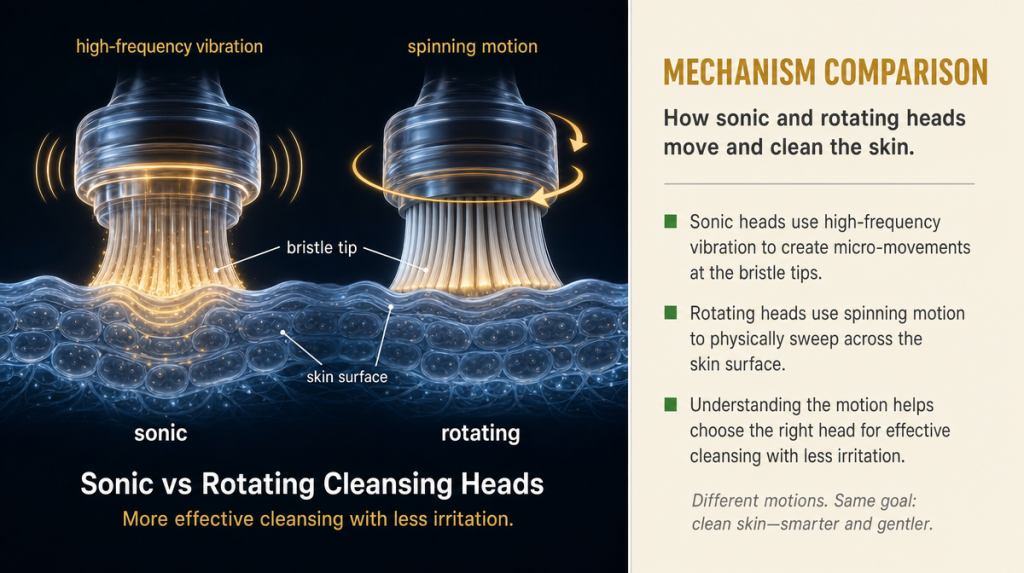
Two mechanisms dominate the category. Sonic devices vibrate at high frequency without the head visibly spinning; rotating devices have a head that physically turns. In practice, sonic motion tends to feel gentler and is generally considered lower-risk for reactive skin, because the bristle tips move across the skin rather than dragging against it. Rotating heads can cover ground more aggressively, which may help with makeup removal but also raises the chance of micro-abrasion at the edges of the head, particularly around the nose and jawline where skin folds create uneven pressure. Neither mechanism is inherently superior; the right choice depends on your skin’s tolerance and the pressure you tend to apply. A useful self-test: run the device dry against the inside of your wrist for ten seconds. If the sensation feels closer to a buzz than a drag, it is likely sonic; if you feel the head rotating under your fingers, it is likely a rotating design.
Matching Bristle Stiffness To Your Skin Type
Bristle material sorts broadly into two families: silicone, which is smooth, non-porous, and generally softer on the skin, and nylon, which is stiffer and more textured. Silicone tends to suit sensitive, rosacea-prone, or easily flushed skin, since it distributes pressure more evenly and holds less bacteria between uses. Nylon can suit thicker, oil-prone skin that tolerates more friction well, but it is also more likely to aggravate skin already under stress.
> Visible redness that lingers for more than twenty minutes after use, or a stinging sensation during use, is the skin signaling that the bristle is too stiff for that day, not necessarily for that person permanently. > — Dr. Claire Dubois, MD, Board-certified dermatologist
That distinction matters: skin tolerance changes with the season, with sun exposure, and even with hormonal cycles, so a bristle that felt fine in July may feel abrasive in a dry February.
The Cleanser Still Does The Work
A cleansing brush is a delivery mechanism, not a replacement for the cleanser itself. If the formula underneath is too harsh — stripping, heavily fragranced, or simply mismatched to your skin type — adding mechanical motion on top of it tends to intensify the irritation rather than the cleansing. Dermatologists interviewed for this piece consistently note that the device should be chosen after the cleanser, not before it. A gentle, pH-balanced cleanser paired with a soft silicone head is a fundamentally different experience than a foaming, sulfate-heavy cleanser paired with a stiff rotating brush, even though both combinations look identical in a bathroom cabinet. The common mistake is assuming the device compensates for a mismatched cleanser; in practice it usually magnifies the mismatch.
The Overuse Mistake Almost Everyone Makes
The single most common error is frequency, not device choice. Many people begin using a new cleansing brush twice daily from the first day, treating it like a toothbrush. Skin is not enamel; the outermost layer is a living barrier that can be visibly disrupted by repeated mechanical stress before it has a chance to recover. A more realistic starting point is two to three uses per week, increasing gradually only if the skin shows no redness, tightness, or small bumps the following morning. Signs of overuse include a persistent pink flush, a rough or bumpy texture where the skin used to be smooth, and a sensation of tightness that does not ease within twenty minutes of moisturizing. If any of these appear, the fix is almost always frequency, not a different device.
Judging Real Results Versus Placebo Glow
Immediately after using a cleansing brush, skin often looks brighter simply because increased blood flow to the surface creates a temporary flush — a real but short-lived effect that should not be confused with lasting improvement in texture. Genuine change, such as smoother texture or fewer visible clogged pores, tends to take four to six weeks of consistent, appropriately gentle use to become noticeable, according to dermatologists who study skin barrier response. The most reliable way to judge progress is a simple self-test: photograph your bare, freshly cleansed face in the same window light once a week, at the same time of day, without makeup. Comparing week one to week six is far more informative than comparing how your skin looks immediately before and after a single session.
Keeping The Device Clean Enough To Trust
A cleansing brush sits in a humid bathroom and touches the face daily, which makes it a natural place for bacteria to accumulate if it is not cared for. General public guidance on cosmetic devices recommends rinsing the head thoroughly after each use, letting it air dry fully rather than storing it in a closed container while damp, and replacing the head on a regular schedule, typically every three months, since bristles and silicone surfaces can degrade and harbor buildup over time. Skipping this maintenance does not just shorten the device’s lifespan; it can reintroduce onto freshly cleansed skin the very debris the device was meant to remove.
What Is Marketing And What Actually Matters
Certain features are worth paying attention to: a documented waterproof rating for shower use, a bristle material clearly disclosed by the manufacturer, and heads that are genuinely replaceable rather than fused to the handle. Certain other features are largely marketing dressing: a headline number of “pulses per minute” with no context for what that number means for your skin, app connectivity that tracks usage without changing the mechanism touching your face, or colored LED lights with no independently explained function. Before buying, or before continuing to use a device you already own, it helps to ask a plain question: does this feature change what happens on my skin, or does it only change what happens on the box.
Key Takeaways
A cleansing brush is a mechanical tool layered onto the skin you already have, not a shortcut around it. The motion — sonic or rotating — matters less than the frequency of use and the bristle’s match to your skin’s current tolerance. The cleanser underneath still does most of the chemical work; the device simply helps deliver it more evenly. Real results, if they come, tend to show up over weeks, not overnight, and are best judged with consistent photos rather than the immediate post-wash flush.
A Five-minute Checklist Before You Buy Or Keep Using One
- Confirm the bristle material (silicone or nylon) and match it to how your skin has behaved this season
- Start at two to three uses per week, not daily, regardless of what the packaging suggests
- Pair the device with a cleanser suited to your skin type, not the one bundled with it
- Replace the head on a regular schedule and let it air dry fully between uses
- Track results with weekly photos in consistent light, not a single before-and-after
Sources
1. American Academy of Dermatology, public consumer guidance on cleansing and skin care routines, 2023
2. Mayo Clinic, “Skin care: 5 tips for healthy skin,” general public guidance
3. Journal of Cosmetic Dermatology, study on mechanical facial cleansing devices and skin surface debris removal, 2019
4. U.S. Food and Drug Administration, general consumer guidance on cosmetic device hygiene and safety
Professor Margareta Lindberg, MD, PhD — Dermatologist and researcher with extensive experience studying skin aging, barrier function, and connective tissue.
Dr. James Morrison, PhD — Biochemist with a research background in dermal delivery and formulation science.
Dr. Claire Dubois, MD — Board-certified dermatologist with experience in cosmetic dermatology and clinical research.
This article is for general information only and is not a substitute for personalized medical or dermatological advice.
Individual skin response varies; results and timelines described here may not apply to everyone.